Llama 4 Scout's 10M Token Context: Open-Source Game-Changer for Massive Document AI

Llama 4 Scout’s 10M Token Context: Open-Source Game-Changer for Massive Document AI

Meta’s Llama 4 Scout introduces an unprecedented 10 million token context window that fundamentally changes how enterprises process massive documents, codebases, and datasets. Unlike previous models that required chunking and summarization, Scout processes entire document collections in a single pass—enabling AI applications that were previously impossible with open-source alternatives. This breakthrough represents a 78x increase […]
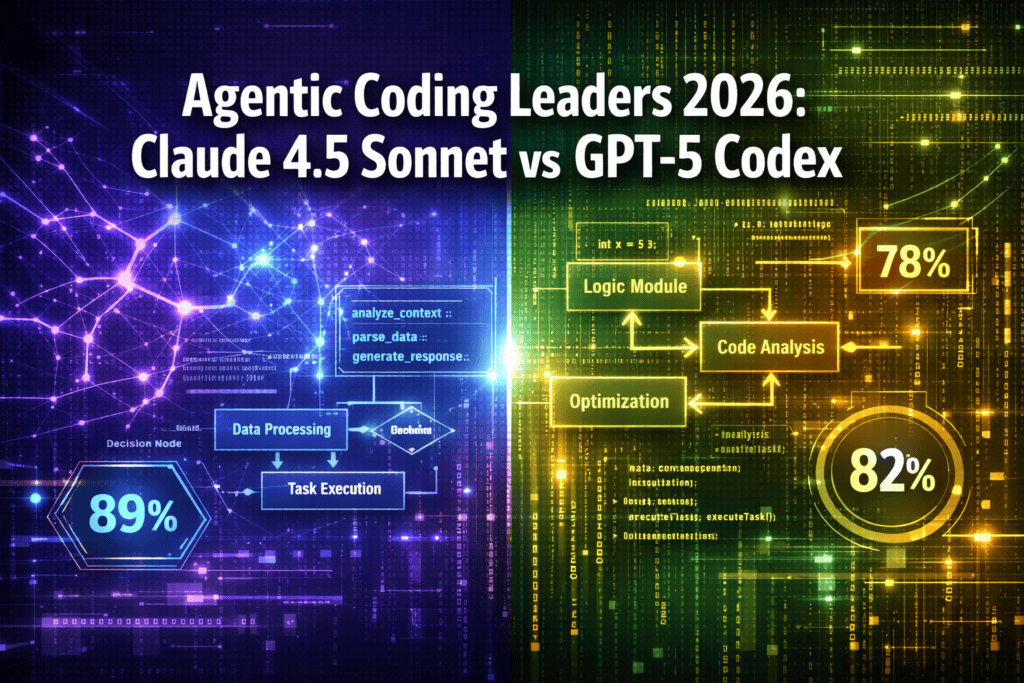
Agentic Coding Leaders 2026: Claude 4.5 Sonnet's Autonomous Hours vs GPT-5 Codex

Agentic Coding Leaders 2026: Claude 4.5 Sonnet’s Autonomous Hours vs GPT-5 Codex

The race for autonomous coding supremacy in 2026 comes down to two fundamentally different architectures: Anthropic’s Claude 4.5 Sonnet with its massive 1-million-token context window versus OpenAI’s GPT-5 Codex with dynamic reasoning depth adjustment. Understanding which model handles multi-hour autonomous coding sessions better requires looking beyond benchmark scores to real-world execution patterns, cost efficiency, and […]

Building Production AI Agents in 2026: Tool Use Benchmarks Across Claude Opus 4.5, GPT-5, and Grok 4

Building Production AI Agents in 2026: Tool Use Benchmarks Across Claude Opus 4.5, GPT-5, and Grok 4

Building production AI agents in 2026 requires choosing the right foundation model for tool use, function calling, and workflow reliability. Claude Opus 4.5, GPT-5, and Grok 4 represent the current state-of-the-art, but their real-world performance varies significantly when handling multi-step tool chains, error recovery, and structured output generation. This guide examines hands-on benchmarks, failure patterns, […]

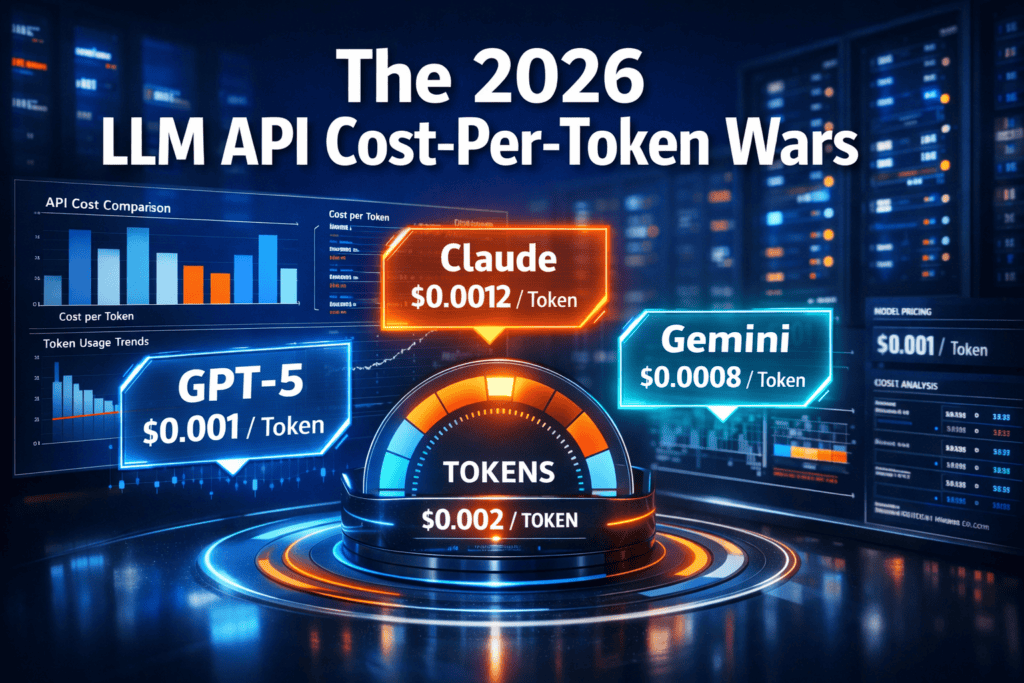
The 2026 LLM API Cost-Per-Token Wars: Why GPT-5 Isn't Always the Cheapest Option for Enterprise Workloads

The 2026 LLM API Cost-Per-Token Wars: Is GPT-5 the Best Option for Enterprise Workloads

The 2026 LLM API Cost-Per-Token Wars: Why GPT-5 Isn’t Always the Best Option for Enterprise Workloads reveals a pricing landscape where premium doesn’t always mean optimal. GPT-5 costs $1.25 per million input tokens and $10.00 per million output tokens—making it 189% more expensive than Claude 4.5 Sonnet for identical enterprise workloads processing 10 million daily […]

Gemini 3.1 Pro vs Claude Sonnet 4.6: February 2026 Benchmark Breakdown and Cost Analysis

Gemini 3.1 Pro vs Claude Sonnet 4.6: 2026 Benchmark Breakdown and Cost Analysis

February 2026 delivered two heavyweight AI model releases that reshaped enterprise deployment decisions. Google’s Gemini 3.1 Pro and Anthropic’s Claude Sonnet 4.6 arrived within days of each other, sparking immediate debate about which model delivers better value for production workloads. This Gemini 3.1 Pro vs Claude Sonnet 4.6: February 2026 Benchmark Breakdown and Cost Analysis […]

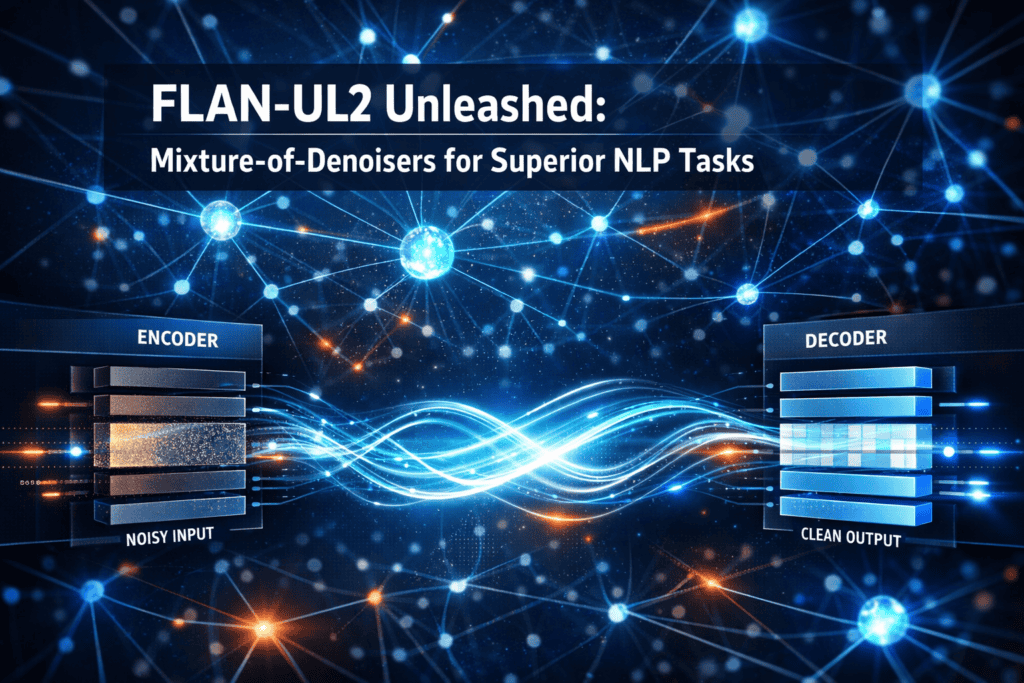
FLAN-UL2 Unleashed: Mixture-of-Denoisers for Superior NLP Tasks in Research and Production

FLAN-UL2 Unleashed: Mixture-of-Denoisers for Superior NLP Tasks in Research and Production

FLAN-UL2 represents a breakthrough in encoder-decoder language models by combining Mixture-of-Denoisers (MoD) pre-training with instruction tuning to deliver state-of-the-art performance across question answering, reasoning, and summarization tasks. This 20-billion-parameter model achieves accuracy comparable to models three times its size while running 7-8 times faster, making it a practical choice for both research experimentation and production […]

Vicuna's Chatbot Supremacy: Open-Source Evolution from Alpaca to Enterprise-Grade Conversational AI

Vicuna’s Chatbot Supremacy: Open-Source Evolution from Alpaca to Enterprise-Grade Conversational AI

Vicuna-13B represents a watershed moment in open-source conversational AI—delivering enterprise-grade performance through transparent training methods, RLHF optimization, and deployment flexibility that proprietary models can’t match. Built on LLaMA foundations and refined with 70,000 real user conversations, Vicuna’s evolution from Alpaca to StableVicuna demonstrates how structured responses, edge-device compatibility, and agent framework integration create practical advantages […]

Kimi Linear from Moonshot AI: Efficient Attention for 1M+ Context Windows and Agentic Apps

Kimi Linear from Moonshot AI: Efficient Attention for 1M+ Context Windows and Agentic Apps

Moonshot AI’s Kimi Linear architecture represents a fundamental shift in how large language models handle ultra-long context windows. Released in October 2025, this hybrid linear attention mechanism delivers memory-efficient processing for 256K+ token contexts at a fraction of the computational cost of traditional quadratic attention systems. For developers building real-time agentic applications in 2026, Kimi […]

OpenAI GPT-5 Dual-Model System: Speed vs Reasoning Routing for Enterprise Optimization

OpenAI GPT-5 Dual-Model System: Speed vs Reasoning Routing for Enterprise Optimization

OpenAI’s GPT-5, officially launched on August 7, 2025, introduced a fundamental architectural shift that changed how enterprises deploy AI: an intelligent router that automatically selects between high-throughput speed processing and deep reasoning modes based on query complexity. The OpenAI GPT-5 Dual-Model System: Speed vs Reasoning Routing for Enterprise Optimization eliminates manual model selection and delivers […]

xAI's Grok 4 Uncensored: Real-World Applications and Ethical Deployment Strategies in 2026

xAI’s Grok 4 Uncensored: Real-World Applications and Ethical Deployment Strategies in 2026

xAI’s Grok 4 represents a fundamental shift in how organizations approach AI deployment—combining uncensored reasoning capabilities with real-time data access from X (formerly Twitter) to power dynamic, context-aware applications. Understanding xAI’s Grok 4 Uncensored: Real-World Applications and Ethical Deployment Strategies in 2026 means grasping both the technical advantages of its training approach and the governance […]

Access 300+ Premium AI Models & Compare Responses Side-By-Side