Spanish-speaking markets represent over 580 million people worldwide, making Spanish the second most spoken native language globally. For content creators targeting these audiences in 2026, choosing the right AI model isn’t just about translation accuracy—it’s about cultural fluency, regional nuance, and the ability to capture the distinct voice of Spanish-speaking communities from Madrid to Mexico City. The Spanish Language AI Wars: GPT-4o vs Gemini 2.0 vs Claude for Global Content Creators has become a critical decision point as these three frontier models compete for dominance in multilingual content generation.
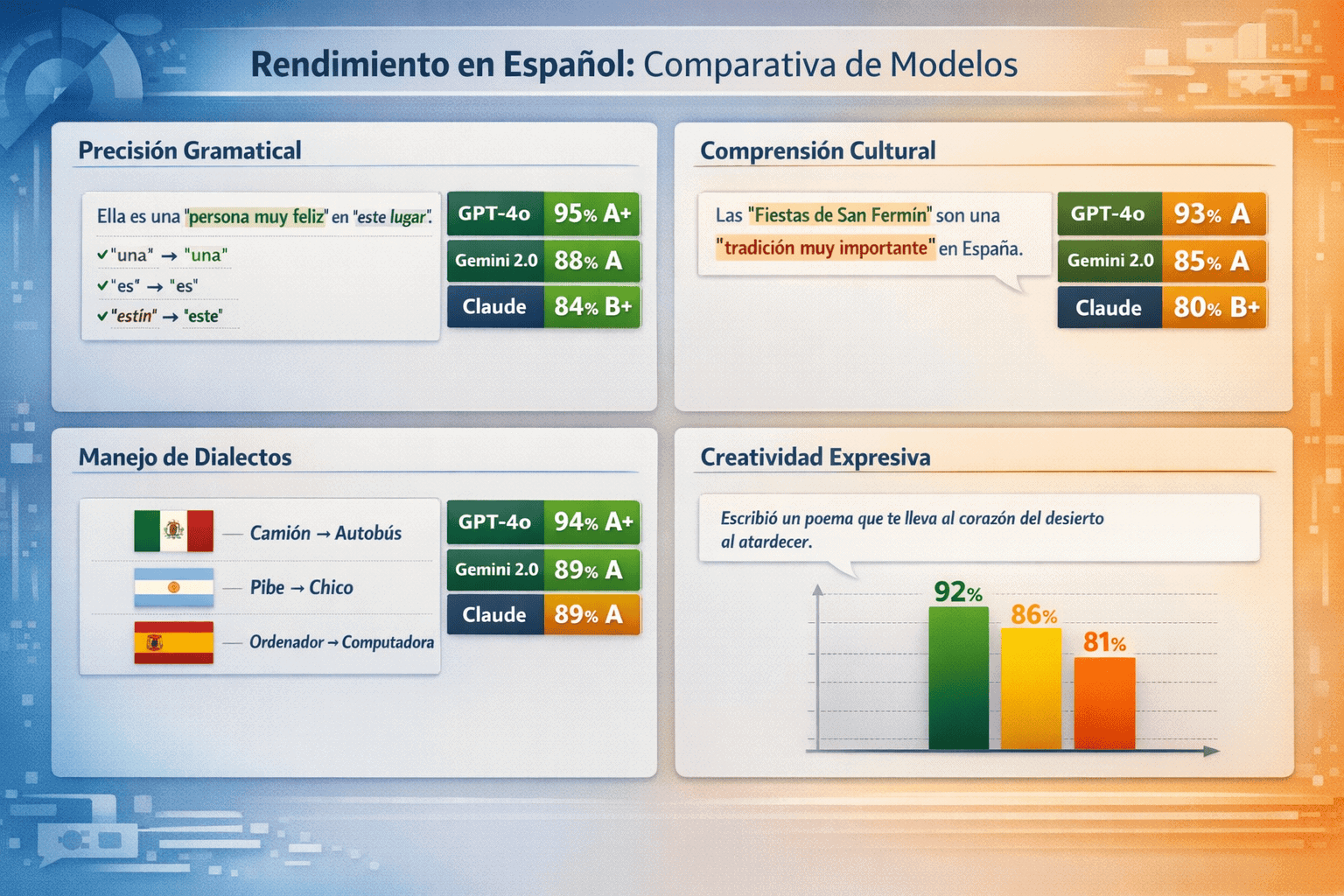
GPT-4o maintains a slight edge in Spanish language quality, particularly in cultural nuances and idiomatic expressions, though both GPT-4o and Gemini have significantly improved their Spanish capabilities throughout 2026.[5] Claude brings exceptional reasoning and structure to Spanish content, while Gemini 2.0 offers unmatched multimodal processing for visual content across Spanish markets. The choice between these models depends on your specific content needs, budget constraints, and the regional Spanish variants you’re targeting.
- Key Takeaways
- Quick Answer
- How Do GPT-4o, Gemini 2.0, and Claude Compare for Spanish Language Quality?
- What Are the Pricing Differences for Spanish Content Creation Across These Models?
- Which Model Handles Regional Spanish Variants and Cultural Nuances Best?
- How Do These Models Perform for Different Spanish Content Types?
- What Are the Multilingual Capabilities Beyond Spanish for Global Content Creators?
- How Can Content Creators Test and Compare These Models for Spanish Content?
- What Role Do Context Windows Play in Spanish Content Creation?
- How Do These Models Compare for Spanish SEO Content Creation?
- What Are the Limitations and Challenges of Each Model for Spanish Content?
- FAQ
- Conclusion
- References
Key Takeaways
- GPT-4o leads in cultural nuance and idiomatic Spanish, making it the top choice for creative content, marketing copy, and region-specific communication across diverse Spanish-speaking markets
- Gemini 2.0 excels at multimodal Spanish content with its 1 million token context window, ideal for processing long documents, videos, and visual content for Spanish audiences
- Claude Opus 4.5 provides superior structure and reasoning for technical Spanish content, documentation, and analytical writing, though at approximately 3× the cost of GPT models[4]
- Pricing varies dramatically: GPT-5 offers the most economical option at $1.25/$10 per million tokens, while Claude Opus costs roughly 75× more than budget alternatives[3][4]
- Regional Spanish variants matter: GPT-4o shows the strongest performance in handling differences between Castilian, Mexican, Argentine, and other Spanish dialects
- All three models improved Spanish capabilities in 2026, with GPT-4o and Gemini showing the most significant gains in colloquial usage and cultural context[5]
- Choose GPT-4o for marketing and creative work, Gemini 2.0 for multimodal projects, and Claude for technical documentation requiring precise structure
- The MULTIBLY platform lets you compare all three models side-by-side for Spanish content tasks, helping you identify which performs best for your specific use case
Quick Answer
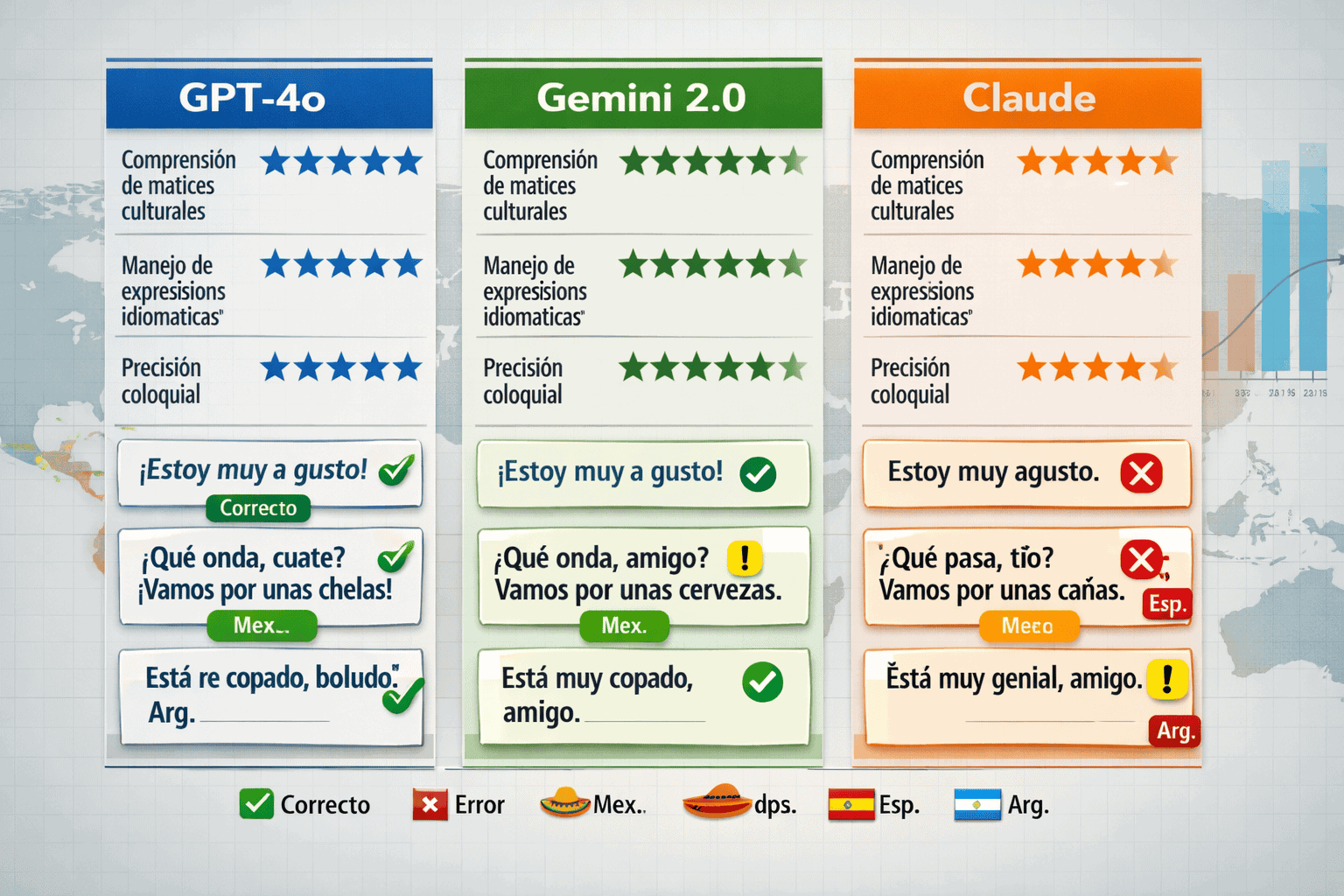
GPT-4o currently leads in Spanish language quality for most content creation tasks, particularly excelling at cultural nuances, regional idioms, and colloquial expressions that resonate with native speakers.[5] Gemini 2.0 offers the best multimodal capabilities for Spanish content involving images, videos, or long documents, while Claude Opus 4.5 provides superior reasoning and structure for technical Spanish writing. For budget-conscious creators, GPT-5.2 delivers strong Spanish performance at the most economical pricing among frontier models.[3]
How Do GPT-4o, Gemini 2.0, and Claude Compare for Spanish Language Quality?
GPT-4o maintains the strongest overall Spanish language performance in 2026, especially for content requiring cultural sensitivity and regional authenticity. Both GPT-4o and Gemini have significantly improved their Spanish capabilities throughout 2026, with notable gains in handling colloquialisms and context-specific usage.[5]
The key differences emerge in specific use cases:
GPT-4o strengths:
- Superior handling of Spanish idioms and colloquial expressions
- Better understanding of cultural references across Spanish-speaking regions
- More natural-sounding creative content and marketing copy
- Strong performance with regional variants (Mexican Spanish, Argentine Spanish, Castilian Spanish)
- Excellent at maintaining consistent tone and voice in Spanish
Gemini 2.0 strengths:
- Best multimodal processing for Spanish content involving images or video
- 1 million token context window enables processing of extensive Spanish documents[1]
- Strong technical translation capabilities
- Effective at handling mixed-language content (Spanish-English code-switching)
- Faster processing speeds for high-volume Spanish content tasks
Claude Opus 4.5 strengths:
- Most structured and logical Spanish output for technical documentation
- Superior reasoning capabilities for complex Spanish analytical content
- Excellent at maintaining formal register in professional Spanish
- Best for legal, medical, or technical Spanish requiring precision
- Strong performance in Spanish coding documentation and technical writing
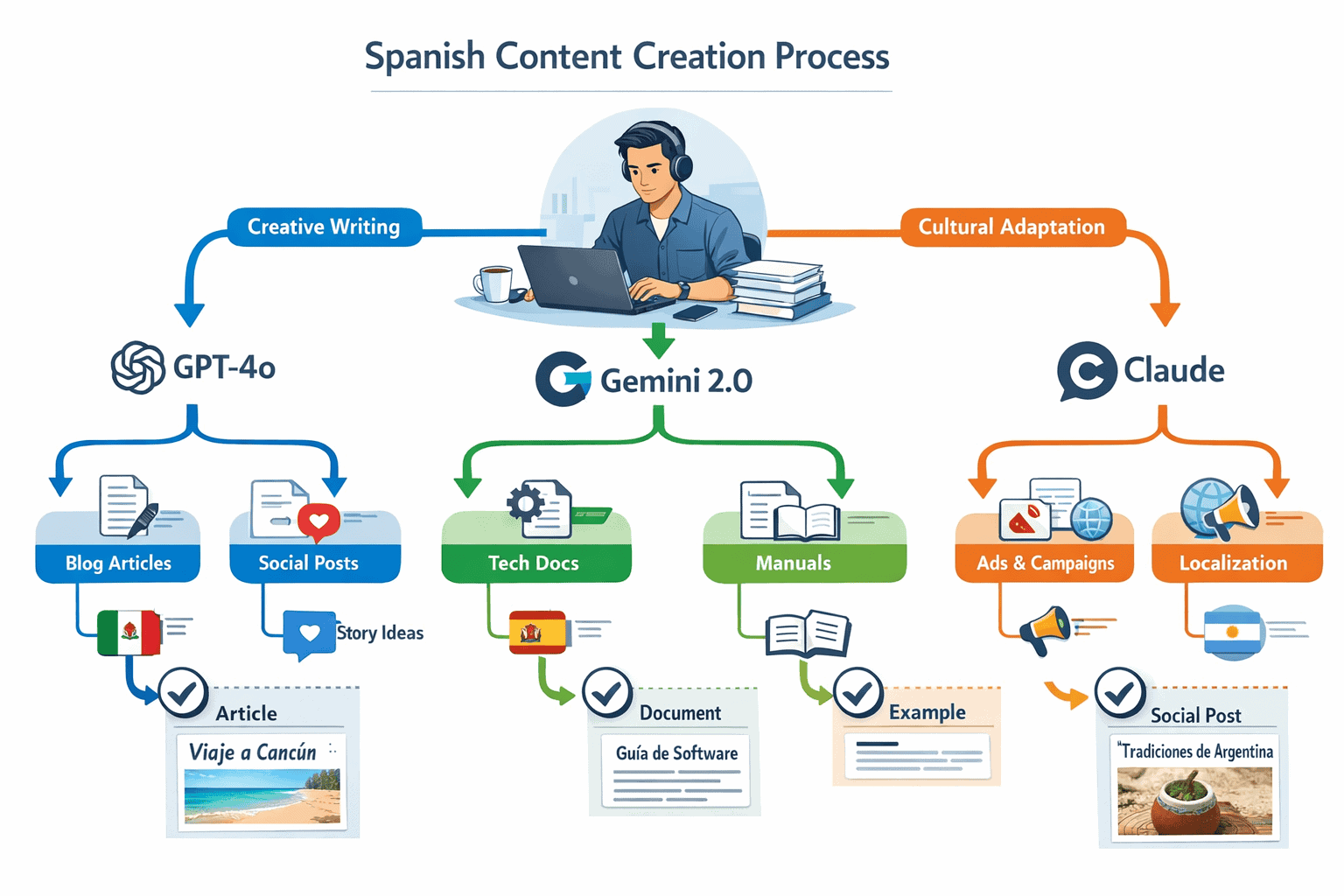
In practice, GPT-4o wins for marketing campaigns targeting Spanish-speaking audiences, blog content, social media posts, and any creative writing where cultural resonance matters. Gemini 2.0 becomes the better choice when working with Spanish-language videos, processing large Spanish documents, or creating content that combines text and visual elements. Claude excels when you need technically precise Spanish with clear logical structure.
Common mistake: Assuming all Spanish is the same. A marketing campaign that works perfectly in Spain might fall flat in Mexico or Argentina due to vocabulary differences, cultural references, and regional expressions. GPT-4o shows the strongest awareness of these regional distinctions.
What Are the Pricing Differences for Spanish Content Creation Across These Models?
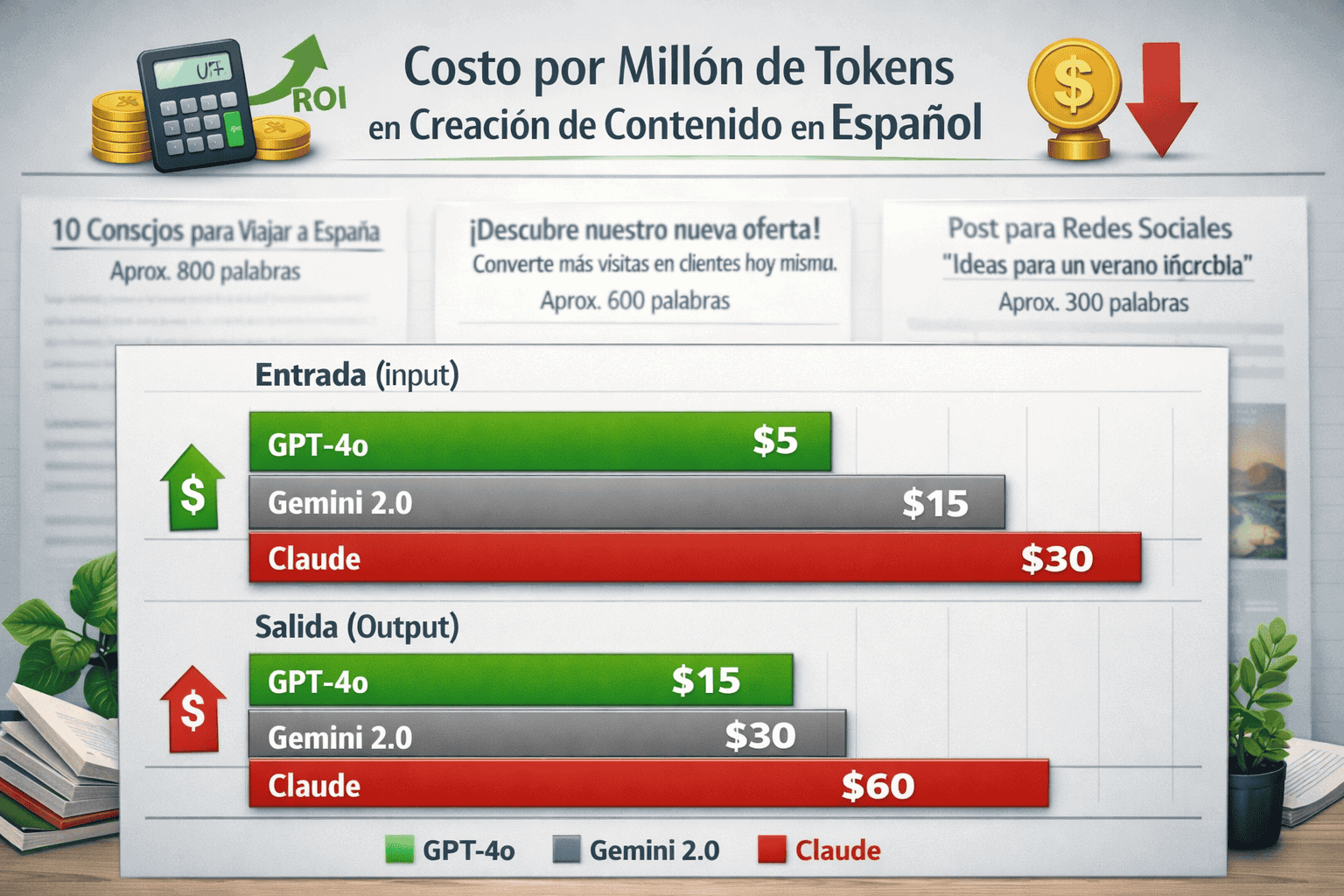
GPT-5.2 offers the most economical pricing at $1.25 per million input tokens and $10 per million output tokens, making it the budget-friendly choice for high-volume Spanish content production.[3] Gemini pricing falls in the middle tier, while Claude Opus represents the premium option at approximately 3× the cost of GPT models and 75× more than budget alternatives like Grok.[4]
Here’s the practical breakdown:
| Model | Input Cost (per 1M tokens) | Output Cost (per 1M tokens) | Best Value For |
|---|---|---|---|
| GPT-5.2 | $1.25 | $10.00 | High-volume Spanish content, blogs, social media |
| Gemini 2.0 Pro | ~$3.50 | ~$14.00 | Multimodal Spanish projects, document processing |
| Claude Opus 4.5 | ~$15.00 | ~$75.00 | Technical Spanish, legal documents, precision work |
Real-world cost example: Creating 50 Spanish blog posts (averaging 1,500 words each, approximately 2,000 tokens per post):
- GPT-5.2: ~$1.13 total (100,000 tokens output)
- Gemini 2.0: ~$1.40 total
- Claude Opus 4.5: ~$7.50 total
For most content creators working in Spanish, GPT-5.2 provides the best balance of quality and cost. Choose Claude only when the precision and structure justify the 6-7× price premium. Gemini makes sense when you’re processing Spanish-language videos, images, or documents that exceed the context limits of other models.
Decision rule: Use GPT-5.2 for 80% of your Spanish content needs, Gemini for multimodal projects, and Claude for the 5-10% of content where perfect technical accuracy matters more than cost.
Edge case: If you’re processing extremely long Spanish documents (over 100,000 tokens), Gemini’s 1 million token context window might actually prove more cost-effective than splitting the work across multiple GPT calls.[1]
Which Model Handles Regional Spanish Variants and Cultural Nuances Best?
GPT-4o demonstrates the strongest performance in recognizing and adapting to regional Spanish variants, from Castilian Spanish in Spain to Mexican, Argentine, Colombian, and other Latin American dialects.[5] This matters significantly for content creators because word choices, expressions, and even grammar preferences vary considerably across Spanish-speaking regions.
Regional differences that impact content quality:
Vocabulary variations:
- “Computer” = ordenador (Spain) vs. computadora (Latin America)
- “Car” = coche (Spain) vs. carro (most Latin America) vs. auto (Argentina)
- “To drive” = conducir (Spain) vs. manejar (Latin America)
Grammatical preferences:
- Vosotros form (Spain) vs. ustedes (Latin America)
- Pretérito vs. pretérito perfecto usage varies by region
- Voseo in Argentina and parts of Central America
Cultural references and idioms:
- “Estar en la luna” (Spain) vs. “Estar en las nubes” (Mexico) for “daydreaming”
- Different slang terms for common concepts
- Regional humor and cultural touchpoints
GPT-4o shows the most consistent ability to maintain regional consistency when you specify your target market. For example, when prompted to write for a Mexican audience, it naturally uses “computadora” instead of “ordenador” and avoids the vosotros form entirely.
Gemini 2.0 performs adequately with regional variants but occasionally mixes registers, particularly in longer content. Claude tends toward more formal, neutral Spanish that works across regions but may lack the local flavor that makes content feel authentically targeted.
Practical approach: Specify your target region in your prompts (“Write this for a Mexican Spanish-speaking audience” or “Use Argentine Spanish conventions”). GPT-4o responds most reliably to these instructions, while the other models may need more explicit guidance about specific vocabulary choices.
For global Spanish content that needs to work across all regions, use neutral Latin American Spanish and avoid region-specific slang—all three models can handle this, but GPT-4o requires the least prompt engineering to achieve it.
How Do These Models Perform for Different Spanish Content Types?
Each model shows distinct advantages depending on the type of Spanish content you’re creating. Understanding these performance differences helps you match the right tool to each specific task.
Creative and Marketing Content
Best choice: GPT-4o
GPT-4o excels at:
- Blog posts and articles with engaging narratives
- Social media content requiring personality and voice
- Marketing copy that needs cultural resonance
- Email campaigns targeting Spanish-speaking audiences
- Creative storytelling and brand content
The model’s superior handling of idioms, colloquialisms, and cultural references makes Spanish marketing content feel authentic rather than translated. It naturally incorporates the emotional and persuasive elements that drive engagement in Spanish-speaking markets.
Technical Documentation and Analysis
Best choice: Claude Opus 4.5
Claude dominates for:
- Technical manuals and user documentation in Spanish
- Legal documents requiring precision
- Medical or scientific content
- Analytical reports and data interpretation
- Software documentation and API guides
Claude’s structured reasoning capabilities ensure technical Spanish content maintains logical flow and terminological consistency. The premium pricing makes sense here because errors in technical or legal Spanish content can be costly.[1]
Multimodal and Long-Form Content
Best choice: Gemini 2.0
Gemini leads in:
- Spanish-language video script creation with visual context
- Processing long Spanish documents (contracts, books, research papers)
- Content combining Spanish text with images or diagrams
- Transcription and analysis of Spanish audio/video
- Document summarization for lengthy Spanish materials
The 1 million token context window means you can feed Gemini an entire Spanish-language book or lengthy contract and ask questions or create summaries without losing context.[1] This capability is unmatched by GPT-4o or Claude for extremely long Spanish content.
High-Volume Content Production
Best choice: GPT-5.2
For creators producing large quantities of Spanish content:
- Product descriptions for e-commerce
- FAQ sections and help center content
- Social media post batches
- Newsletter content at scale
- SEO-optimized blog content
GPT-5.2’s economical pricing at $1.25/$10 per million tokens makes it practical for high-volume Spanish content needs where the slight quality difference from GPT-4o doesn’t justify the cost difference.[3]
Common mistake: Using the same model for all Spanish content tasks. Smart creators use MULTIBLY’s side-by-side comparison to test all three models for each content type, then standardize on the best performer for each category.
What Are the Multilingual Capabilities Beyond Spanish for Global Content Creators?
While this analysis focuses on Spanish, global content creators often need AI models that perform well across multiple languages. Understanding how these models handle other languages helps you build a complete multilingual content strategy.
All three frontier models support 100+ languages, but performance varies significantly:
GPT-4o strengths:
- Consistent quality across major European languages (French, German, Italian, Portuguese)
- Strong performance in major Asian languages (Mandarin, Japanese, Korean)
- Best for maintaining brand voice across multiple languages
- Reliable for Romance languages closely related to Spanish
Gemini 2.0 strengths:
- Excellent multilingual document processing
- Strong performance in Indian languages (Hindi, Tamil, Bengali)
- Best for mixed-language content and code-switching
- Superior at handling multilingual visual content
Claude Opus 4.5 strengths:
- Most consistent technical terminology across languages
- Strong performance in formal business languages
- Best for multilingual legal and compliance content
- Reliable for technical documentation in multiple languages
For content creators managing Spanish alongside other languages, GPT-4o typically provides the most consistent quality across your entire language portfolio. Qwen3 from Alibaba and StableLM 2 offer strong open-source alternatives for multilingual content, particularly for Asian and European languages.
Decision framework: If Spanish is your primary language but you occasionally need French, Portuguese, or Italian content, GPT-4o provides the most consistent cross-language performance. If you’re working with Spanish plus Asian languages, consider testing Gemini 2.0 or specialized multilingual models through MULTIBLY’s platform.
How Can Content Creators Test and Compare These Models for Spanish Content?
The most effective approach is direct comparison testing with your actual Spanish content needs. Rather than relying solely on benchmarks or general reviews, test each model with representative samples of your specific content types.
Practical testing framework:
Select 3-5 representative content samples:
- One creative/marketing piece
- One technical or informational piece
- One piece requiring regional Spanish specificity
- One long-form content sample
- One piece with cultural references or idioms
Create standardized prompts:
- Use identical prompts across all three models
- Specify your target audience and regional variant
- Include context about tone, style, and purpose
- Request specific length and format requirements
Evaluate outputs on:
- Cultural authenticity and regional appropriateness
- Grammar and linguistic accuracy
- Natural flow and readability
- Appropriate use of idioms and colloquialisms
- Consistency with your brand voice
- Cost per piece based on token usage
Use MULTIBLY for side-by-side comparison:
- MULTIBLY’s platform lets you run the same prompt across GPT-4o, Gemini 2.0, and Claude simultaneously
- Compare outputs directly without switching between different interfaces
- Track costs across models for your specific use cases
- Build a library of prompts that work best for each model
Evaluation criteria for Spanish content quality:
- Native speaker review: Have Spanish-speaking team members or contractors review outputs from each model
- Regional appropriateness: Verify the content uses vocabulary and expressions natural to your target market
- Cultural sensitivity: Check for potential cultural missteps or references that don’t translate
- Consistency: Test whether the model maintains voice and terminology across multiple pieces
- Error rate: Track grammatical errors, awkward phrasing, or unnatural constructions
Testing timeline: Plan for 1-2 weeks of structured testing before committing to a primary model for Spanish content. The investment in proper evaluation saves significantly on revision costs and quality issues down the line.
Edge case: If you’re creating Spanish content for highly specialized domains (medical, legal, financial), include subject matter experts in your evaluation process. Technical accuracy matters more than linguistic fluency in these contexts, which may shift your model choice toward Claude despite the higher cost.
What Role Do Context Windows Play in Spanish Content Creation?
Context window size determines how much information an AI model can process and remember within a single conversation or task. For Spanish content creators, this impacts everything from document processing to maintaining consistency across long-form content.
Context window comparison:
- Gemini 2.0 Pro: 1 million tokens (approximately 750,000 words)[1]
- GPT-4o: 128,000 tokens (approximately 96,000 words)
- Claude Opus 4.5: 200,000 tokens (approximately 150,000 words)
Practical implications for Spanish content:
Large context windows enable:
- Processing entire Spanish-language books or lengthy contracts in one session
- Maintaining character voices and plot consistency across novel-length Spanish fiction
- Analyzing comprehensive Spanish market research reports without chunking
- Translating and adapting lengthy technical manuals while maintaining terminology consistency
- Creating content series where the model remembers all previous installments
When context window size matters most:
- Summarizing Spanish-language research papers or legal documents
- Creating serialized Spanish content (blog series, course materials)
- Adapting lengthy English content into Spanish while maintaining consistency
- Processing customer feedback or survey responses in Spanish
- Building comprehensive Spanish knowledge bases or documentation sets
For most Spanish content creation tasks (blog posts, social media, marketing copy), the standard context windows of GPT-4o and Claude prove sufficient. Gemini’s 1 million token window becomes valuable primarily when working with extremely long Spanish documents or when you need the model to maintain context across extensive content series.
Cost consideration: While Gemini’s massive context window is impressive, remember that filling it with tokens costs money. A full 1 million token context at Gemini’s pricing would cost approximately $3.50 just for input tokens, before generating any output. Use the extended context strategically rather than as a default approach.
For more insights on how context windows impact AI model selection, see our analysis of long-context LLMs in production.
How Do These Models Compare for Spanish SEO Content Creation?
Spanish-language SEO content requires both linguistic quality and search optimization understanding, making model selection particularly important for content creators targeting Spanish-speaking markets through organic search.
GPT-4o leads for Spanish SEO content because it better understands:
- Natural keyword integration in Spanish without awkward phrasing
- Cultural search intent variations across Spanish-speaking regions
- Local search patterns and regional terminology differences
- Meta descriptions and titles that resonate with Spanish-speaking searchers
- Content structure that matches Spanish-language search behavior
Key considerations for Spanish SEO content:
Regional search behavior varies:
- Spanish searchers in Spain use different query patterns than Mexican searchers
- Local terminology affects keyword research (ordenador vs. computadora)
- Cultural references in titles and meta descriptions impact click-through rates
- Regional competitors require localized content strategies
All three models can:
- Generate Spanish content optimized for target keywords
- Create meta titles and descriptions in Spanish
- Structure content with proper heading hierarchy
- Incorporate semantic keyword variations naturally
- Adapt content length to match search intent
GPT-4o advantages for Spanish SEO:
- More natural keyword integration that doesn’t feel forced
- Better understanding of regional search intent variations
- Superior headline creation that balances keywords and engagement
- More authentic-sounding content that earns longer dwell times
- Better at creating content that matches featured snippet formats in Spanish
Gemini 2.0 advantages:
- Can process competitor content at scale for Spanish market analysis
- Strong at creating Spanish content that incorporates visual elements
- Effective for local SEO content requiring geographic context
- Good at generating Spanish FAQ sections optimized for voice search
Claude advantages:
- Most structured approach to Spanish informational content
- Best for creating comprehensive Spanish guides and resources
- Superior at maintaining topical authority across content clusters
- Excellent for technical Spanish content targeting professional searchers
Practical approach for Spanish SEO content:
- Use GPT-4o for most blog posts, landing pages, and commercial content
- Use Gemini when creating Spanish content with significant visual components
- Use Claude for in-depth Spanish guides, whitepapers, and authoritative resources
- Test all three models through MULTIBLY to identify which performs best for your specific Spanish keywords and topics
Common mistake: Translating English SEO content to Spanish rather than creating Spanish-native content. Search intent often differs between languages, and direct translation rarely produces optimal Spanish SEO results. All three models perform better when prompted to create original Spanish content rather than translate existing English content.
What Are the Limitations and Challenges of Each Model for Spanish Content?
Understanding where each model struggles helps content creators anticipate issues and develop workarounds. No model is perfect for Spanish content, and recognizing these limitations prevents quality problems and wasted resources.
GPT-4o Limitations
Occasional regional inconsistency:
- May mix Spanish variants within longer content (e.g., using both “ordenador” and “computadora”)
- Sometimes defaults to neutral Latin American Spanish when regional specificity was requested
- Can struggle with very niche regional slang or extremely localized expressions
Workaround: Include specific regional vocabulary examples in your prompts and explicitly state which terms to use or avoid.
Cultural reference gaps:
- May miss subtle cultural nuances in highly localized content
- Occasionally suggests cultural references that don’t resonate in target markets
- Can default to more widely known cultural touchpoints rather than region-specific ones
Workaround: Provide cultural context in prompts and have native speakers review content for cultural appropriateness.
Gemini 2.0 Limitations
Inconsistent creative quality:
- Spanish creative content sometimes feels more mechanical than GPT-4o output
- May struggle with maintaining consistent voice in longer Spanish narratives
- Occasionally produces less natural-sounding marketing copy
Workaround: Use Gemini for its multimodal strengths and document processing, but consider GPT-4o for purely creative Spanish content.
Regional variant mixing:
- More prone to mixing Spanish variants than GPT-4o
- May require more explicit prompting to maintain regional consistency
- Sometimes defaults to Castilian Spanish constructions even when Latin American Spanish was requested
Workaround: Provide explicit vocabulary lists and regional preferences in your system prompts.
Claude Opus 4.5 Limitations
Overly formal register:
- Spanish output tends toward formal register even when conversational tone was requested
- May sound stiff or academic in contexts requiring casual Spanish
- Can struggle with colloquial expressions and informal language
Workaround: Explicitly request informal language and provide examples of the desired tone. Consider using GPT-4o for content requiring casual Spanish.
Limited cultural creativity:
- Focuses on logical structure over cultural resonance
- May miss opportunities for culturally relevant metaphors or expressions
- Tends toward universal Spanish rather than region-specific flavor
Workaround: Use Claude for technical content where precision matters more than cultural creativity. Switch to GPT-4o for marketing and creative work.
Cost prohibitive for volume:
- 3× the cost of GPT models makes Claude impractical for high-volume Spanish content[4]
- Premium pricing only justified for content where errors are costly
- Not economical for routine Spanish content creation
Workaround: Reserve Claude for critical technical Spanish content and use GPT-5.2 for volume work.
Universal Challenges Across All Models
Emerging slang and very recent cultural references:
- All models struggle with Spanish slang that emerged after their training cutoff
- May miss very recent cultural events or viral Spanish-language memes
- Can date content by using slightly outdated expressions
Workaround: Stay current with Spanish-language social media and update prompts with current terminology.
Highly specialized domain terminology:
- All models occasionally struggle with very specialized Spanish technical terms
- May inconsistently translate industry-specific jargon
- Can default to English terms when Spanish equivalents exist
Workaround: Provide glossaries of domain-specific Spanish terminology in your prompts.
Verification remains essential:
- No model eliminates the need for native Spanish speaker review
- All models can produce grammatically correct but culturally inappropriate content
- Quality control processes remain critical for professional Spanish content
For comprehensive comparisons of how these models perform across different benchmarks, see our detailed analysis of Claude 4 Sonnet vs GPT-4o.
FAQ
Which AI model is best for Spanish content in 2026?
GPT-4o currently leads for most Spanish content creation tasks, particularly for marketing, creative writing, and content requiring cultural nuance and regional authenticity.[5] Choose Gemini 2.0 for multimodal Spanish projects or extremely long documents, and Claude Opus 4.5 for technical Spanish content requiring precision and structure.
How much does it cost to create Spanish content with these AI models?
GPT-5.2 offers the most economical pricing at $1.25 per million input tokens and $10 per million output tokens, making it ideal for high-volume Spanish content.[3] Gemini 2.0 costs approximately 2-3× more, while Claude Opus 4.5 costs roughly 6-7× more than GPT-5.2 but delivers superior structure for technical content.[4]
Can these AI models handle different Spanish dialects like Mexican Spanish or Castilian Spanish?
Yes, all three models can adapt to regional Spanish variants, but GPT-4o shows the strongest performance in maintaining regional consistency and using appropriate vocabulary for specific markets like Mexico, Spain, Argentina, or Colombia.[5] Specify your target region explicitly in prompts for best results.
Do I need a native Spanish speaker to review AI-generated Spanish content?
Yes, native speaker review remains essential for professional Spanish content. While all three models produce grammatically correct Spanish, they can miss cultural nuances, use inappropriate expressions for specific contexts, or make subtle errors that native speakers catch immediately. Quality control processes should include native speaker review.
Which model is best for Spanish SEO content?
GPT-4o performs best for Spanish SEO content because it more naturally integrates keywords, better understands regional search intent variations, and creates more engaging headlines and meta descriptions that resonate with Spanish-speaking searchers. Its superior handling of cultural nuances also tends to produce content with better engagement metrics.
Can these models translate English content to Spanish effectively?
All three models can translate English to Spanish, but creating original Spanish content typically produces better results than translation. Spanish search intent and cultural context often differ from English, so prompting models to create Spanish-native content rather than translate usually yields more effective results for marketing and SEO purposes.
How do I choose between GPT-4o and Gemini 2.0 for Spanish content?
Choose GPT-4o for creative content, marketing copy, blog posts, and any Spanish content where cultural authenticity and natural language matter most. Choose Gemini 2.0 when working with Spanish-language videos, processing documents longer than 100,000 words, or creating content that combines Spanish text with visual elements.
Is Claude worth the premium price for Spanish content?
Claude Opus 4.5 justifies its premium pricing (approximately 3× more than GPT models) primarily for technical Spanish content where precision matters more than cost—legal documents, medical content, technical manuals, or analytical reports.[4] For most creative and marketing Spanish content, GPT-4o delivers better value.
Can I use these models for Spanish content in specialized industries like legal or medical?
Yes, but Claude Opus 4.5 performs best for specialized Spanish content requiring technical precision in fields like law, medicine, finance, or engineering. Always have domain experts review AI-generated specialized content, as terminology precision and regulatory compliance are critical in these fields.
How can I test which model works best for my Spanish content needs?
Use MULTIBLY’s platform to run identical prompts across GPT-4o, Gemini 2.0, and Claude simultaneously, comparing outputs side-by-side. Test with 3-5 representative samples of your actual content types, evaluate based on your specific quality criteria, and track costs to determine which model delivers the best value for your use cases.
Do these models understand Spanish cultural references and humor?
GPT-4o demonstrates the strongest understanding of Spanish cultural references, idioms, and humor, though all models have limitations with very recent cultural events or highly localized references.[5] Provide cultural context in prompts and have native speakers review content to ensure cultural appropriateness and resonance with your target audience.
Can these models maintain consistent Spanish terminology across large content projects?
Yes, particularly when using Gemini 2.0’s 1 million token context window for extremely large projects.[1] For most projects, all three models can maintain terminology consistency when you provide glossaries in your prompts and use consistent system instructions. Claude Opus 4.5 shows the most consistent technical terminology usage across long documents.
Conclusion
The Spanish Language AI Wars: GPT-4o vs Gemini 2.0 vs Claude for Global Content Creators represents a critical decision point for anyone creating content for Spanish-speaking audiences in 2026. Each model brings distinct strengths to Spanish content creation, and understanding these differences enables smarter, more cost-effective choices.
GPT-4o emerges as the versatile leader for most Spanish content needs, delivering superior cultural nuance, regional authenticity, and natural-sounding creative content at reasonable pricing. Its improved performance throughout 2026 makes it the default choice for marketing, blogging, social media, and any Spanish content where cultural resonance matters.[5]
Gemini 2.0 claims the multimodal crown, offering unmatched capabilities for Spanish projects involving video, images, or extremely long documents. The 1 million token context window provides unique advantages for comprehensive document processing and maintaining consistency across extensive Spanish content series.[1]
Claude Opus 4.5 dominates technical Spanish content, justifying its premium pricing for legal, medical, and technical documentation where precision and structure outweigh cost considerations. Its reasoning capabilities make it the top choice for analytical Spanish content requiring logical rigor.[1]
Actionable next steps for Spanish content creators:
- Start with comparative testing using MULTIBLY’s platform to run your actual Spanish content prompts across all three models simultaneously
- Establish model-specific workflows based on content type: GPT-4o for creative work, Gemini for multimodal projects, Claude for technical content
- Build prompt libraries optimized for each model’s strengths, including regional specifications and terminology preferences
- Implement native speaker review as a standard quality control step, regardless of which model you use
- Monitor costs carefully by tracking token usage across models and adjusting your model selection based on value delivered
- Stay current with model updates as all three companies continue improving Spanish language capabilities throughout 2026
For content creators managing Spanish alongside other languages, explore our guides on multilingual AI capabilities and enterprise AI adoption strategies.
The Spanish-speaking digital market continues growing rapidly, and choosing the right AI model for your content needs directly impacts your ability to connect authentically with these audiences. Test thoroughly, choose strategically, and leverage the distinct strengths of each model to create Spanish content that resonates culturally while meeting your quality and budget requirements.
References
[1] Chatgpt Vs Claude Vs Gemini Comparison 2026 – https://freeacademy.ai/blog/chatgpt-vs-claude-vs-gemini-comparison-2026
[2] Chatgpt 4o Vs Gemini 2 Pro – https://arka-ai.com/compare/chatgpt-4o-vs-gemini-2-pro
[3] Claude Vs Gemini Vs Chatgpt Code Review – https://gitautoreview.com/blog/claude-vs-gemini-vs-chatgpt-code-review
[4] Ai Api Pricing Comparison Grok Gemini Openai Claude – https://intuitionlabs.ai/articles/ai-api-pricing-comparison-grok-gemini-openai-claude
[5] Ai Comparisons – https://gurusup.com/blog/ai-comparisons
[6] Claude Vs Chatgpt Vs Gemini Vs Deepseek – https://improvado.io/blog/claude-vs-chatgpt-vs-gemini-vs-deepseek
[7] Watch – https://www.youtube.com/watch?v=FbBNLYw_dRE
[8] Benchmarks – https://lmcouncil.ai/benchmarks

Our Fact Checking Process
We prioritize accuracy and integrity in our content. Here's how we maintain high standards:
- Expert Review: All articles are reviewed by subject matter experts.
- Source Validation: Information is backed by credible, up-to-date sources.
- Transparency: We clearly cite references and disclose potential conflicts.
Our Review Board
Our content is carefully reviewed by experienced professionals to ensure accuracy and relevance.
- Qualified Experts: Each article is assessed by specialists with field-specific knowledge.
- Up-to-date Insights: We incorporate the latest research, trends, and standards.
- Commitment to Quality: Reviewers ensure clarity, correctness, and completeness.
Look for the expert-reviewed label to read content you can trust.